
Vepoloxamer: our purified, pharmaceutical-grade poloxamer therapeutic
Poloxamer 188 (P188) is a commercially available non-ionic triblock copolymer — two hydrophilic polyethylene oxide (PEO) arms flanking a hydrophobic polypropylene oxide (PPO) core — used as a surfactant and excipient. Vepoloxamer is LifeRaft's patented purified therapeutic product, in which low molecular weight fractions linked to renal toxicity seen with commercial-grade P188 have been removed.
Unlike most therapeutics, which target a single receptor or enzyme, Vepoloxamer operates at a more fundamental level: the cell membrane itself. It integrates into damaged membranes, speeding cell repair and limiting the cascade effect of reactive oxygenated species damaging yet more tissue.
Characterized Mechanisms of Action
What was historically described as a single mechanism — membrane resealing — is now understood as a coordinated set of activities. Each has been characterized in peer-reviewed publications across multiple laboratories.

Selective Membrane Sealing
The hydrophobic core inserts into membranes only where lipid packing has been disrupted — below a threshold surface pressure — and is squeezed back out as the membrane recovers. This is why the molecule targets damaged cells and why its action is self-limiting.
Limiting the Peroxidation Cascade
Sealed membranes physically interrupt the Reactive Oxygen Species-driven secondary injury cycle that destroys tissue downstream of the initial insult. Polymer hydrophilicity governs the ability to protect membranes from peroxidation. Tissue and cellular damage is often a cascade, with the initial damage to tissue leading to further downstream damage. Vepoloxamer reduces that subsequent cascading damage that is driven by Reactive Oxygen Species.
Anti-Inflammatory Signaling
Sealed membranes prevent spillage of damage-associated molecular patterns that drive inflammation, reducing NF-κB activation and downstream cytokine release across contexts from lung injury to cardiac ischemia.
Endothelial Nitric Oxide Signaling
Recent work in Scientific Reports shows that cardioprotection is mediated through increased endothelial nitric oxide production — a mechanism distinct from membrane sealing. Inhibiting nitric oxide synthase abolishes the protective effect entirely. Characterized in cardiac tissue specifically.
Li et al., Vanderbilt University Medical Center 2025 →When tissue and cells are injured
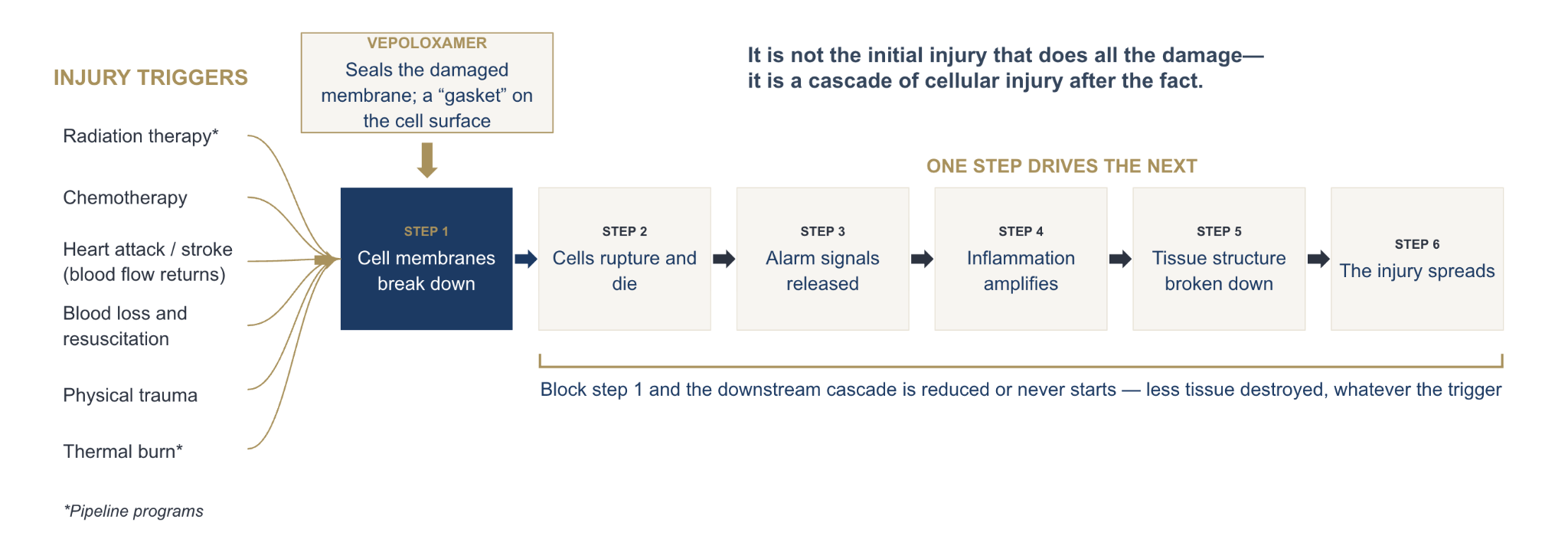
Because the target is a physical state of the cell membrane, the same mechanism applies wherever membranes are being damaged. That is what makes this a platform, not a single-indication drug.
Two Clinical Windows
Dosed Before
- Dosed ahead of a planned, scheduled injury — patients are identified in advance, dosing is elective, and trials enroll on a set schedule.
- Vepoloxamer is immediately sealing cell membrane damage since it is circulating in the patient’s bloodstream when the injury occurs
- Radiation-induced severe oral mucositis — LEAD
- Radiation proctitis, esophagitis, dermatitis, pneumonitis
- Radiological and nuclear countermeasures (BARDA)
- Planned ischemia in surgery and organ preservation
Dosed Soon After: “Time is Tissue”
- Dosed in the hours after an unplanned, emergency injury — patients arrive unannounced, so hospital access and speed to treatment are operational challenges to overcome.
- The therapeutic window (i.e., how soon after the injury must Vepoloxamer be given to have the maximum benefit) is unknown and may vary by injury
- Acute burns — LEAD
- Traumatic brain injury
- Stroke, in combination with standard of care (e.g. thrombectomy)
- Hemorrhagic shock and resuscitation